February 7, 2010

Site maintenance

We’re working on fixing some bugs that people have reported in the last few weeks, including problems with RSS feeds. If something looks off for the next few hours– no worries! We’re on it.


February 5, 2010

National Library of Medicine Exhibit on African American Midwives

For readers around the D.C. area: the National Library of Medicine’s History of Medicine division in Bethesda, MD will run an exhibit through June of this year on the history of African American “granny” midwives. Details below:

Nothing To Work With But Cleanliness: African American “Grannies”, Midwives & Health Reform

For over three centuries, African American midwives delivered babies and practiced folk medicine in rural counties throughout the South. Midwifery came under public scrutiny in the 1910s when progressive reformers blamed the “unsanitary practices” of midwives for the higher rate of maternal and infant deaths. During the next two decades reformers campaigned unsuccessfully to eliminate the practice of midwifery. There simply were not enough skilled physicians or hospital facilities in southern rural communities. Poverty and pervasive racial discrimination also made home births more desirable than hospital deliveries to many of the African American families living in rural counties.

Training midwives was deemed the only viable solution in the South where African Americans midwives were predominate. Midwives received instruction from public health nurses during annual state-sponsored institutes and monthly local midwives clubs. Classes, which emphasized sanitary delivery practices, were taught by demonstration, songs and role playing. From the 1920s through the 1960s this next generation of midwives continued in the tradition of their “granny” predecessors with the added benefit of scientific knowledge.

Through photographs and artifacts, the exhibit tells the story of “granny” midwives and the state and local training programs that educated them and succeeding generations of midwives.

The exhibition, inside and outside the NLM History of Medicine Division Reading Room, Building 38, first floor, runs from February 2010 to June 2010. All are welcome to visit, 8:30 AM to 5:00 PM weekdays, except federal holidays.

Directions, security, parking, etc.: http://www.nlm.nih.gov/hmd/about/visitus.html

For more information: Sheena Morrison, sheena dot morrison at nih dot gov 301.402.8847

[hat tip to a LinkedIn post by Jeffrey Reznick, Deputy Chief, History of Medicine Division, US National Library of Medicine, National Institutes of Health]


February 4, 2010

Sean James and Al Joyner Respond to the Tebow Super Bowl ad

By now you may have heard about the Focus on the Family-sponsored anti-choice ad slated to run during the Super Bowl. The ad features football player Tim Tebow and his mother discussing her decision not to have an abortion when pregnant with the star player.

The ad has been controversial for many reasons, including that it marks a change from CBS’s past “no advocacy/controversy” policy (an ad for a gay dating site was declined), glosses over issues related to privilege and the illegality/safety of abortion in the Philippines, and presents a situation in which Tebow celebrates her own choice (to go through with the pregnancy) and its resultant football star while advocating against other women having the same choice.

We don’t yet know the exact form the ad will take, except that CBS has worked with the anti-choice Focus on the Family on the language, and it will highlight Pam Tebow’s decision not to have an abortion with a tagline of “Celebrate family, celebrate life” (as though one can’t do those things and be pro-choice?).

Planned Parenthood has already released a preemptive response video featuring former football player Sean James and Olympic gold medalist Al Joyner espousing a message we can get behind – one of choice and trusting women. Among their comments:

I respect and honor Mrs. Tebow’s decision. I want my daughter to live in a world world where everyone’s decisions are respected.

We are working toward the day where every woman will be valued. Where every woman’s decision about her health and her family will be respected.

YouTube Preview Image

Related: Jacyln Friedman writes at The Nation about sex and the Super Bowl, arguing that “the Tebow/Focus on the Family ad is just a new expression of a longstanding Super Bowl tradition in which women are valued only in direct relation to their usefulness to male athletes and fans.”


February 3, 2010

Efforts Underway to Respond to Potential Closing of New York Hospital and Associated Birth Center

Following financial struggles and a move by another hospital system to take over, St. Vincent’s Hospital in Manhattan is in danger of closing.  The proposal  has met with community protest, primarily because, as one article notes, “St. Vincent’s treats a disproportionate number of poor, homeless and uninsured patients, who could be forced to go elsewhere for emergency and inpatient care.”

The potential closure has caught the eye of birth choice advocates, as St. Vincent’s houses the The Eli & Abby Manning Birthing Center, created last year to improve birth options at the facility.

According to Choices in Childbirth, St. Vincent’s is:

…currently the only hospital in the City that we know of that is taking strides toward lowering the C-section rate and offering women the option of birthing on their own time. The head of OB, Dr. Mussalli, and his partner Dr. Worth have spent the last year turning things around at St. Vincent’s; introducing the option of birth tubs, providing a home for in-hospital midwifery practices and supporting the homebirth option by signing off on written practice agreements for many of our homebirth midwives and acting as their back-up hospital when transfer from home is necessary.

The organization provides the following suggestions for those interested in becoming involved in the issue:

How you can help:
1. Please visit the new website: www.savestvincents.com and help in whatever ways are at your disposal. Here you can share stories of what St. Vincent’s has meant to you as a parent, provider, or community member. You can also write letters to elected officials

2. Choices in Childbirth is hosting a brainstorming/strategizing meeting for concerned members of the birth community in response to the potential closing of St. Vincent’s Hospital. Drs. Mussalli and/or Worth will attend as well. If you’re interested in getting involved please come to this meeting or contact us at Choices in Childbirth if you’re unable to attend.

Tuesday, February 2
6:45 P.M.
859 Broadway, 3rd floor
@ 17th street
(trains to Union Sq)

Please RSVP to laure at choicesinchildbirth dot org


February 2, 2010

Update: Call for Participants to Help Update “Our Bodies, Ourselves”

Wow.

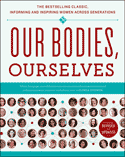
Last week we asked for your help in updating the sexual relationships section in the next edition of “Our Bodies, Ourselves” (Simon & Schuster, 2011). We had no idea what response we would receive to an invitation to join an online discussion that touches on many personal issues.

Would people be interested? Would they be willing to share?

The short answer is an overwhelming “Yes.”

The response has been amazing — we’ve received hundreds of submissions, so many that we’re going to move the deadline up to Wednesday, Feb. 3.

But! We will need input on other chapters in the coming months. We probably won’t be able to do another online discussion, but we’ll ask for specific stories and anecdotes to help personalize and add insight to the topics covered throughout the book.

We’ve flagged some of the relationship submissions for this purpose. So many of you were incredibly forthcoming about other aspects of your lives — as mothers, as survivors of sexual and domestic abuse, as feminists taking on sexism — and we may get in touch with you for permission to include your perspective in another section.

The editorial team working on the 2011 edition has been so moved by the generosity and support of OBOS readers. A big thank you from all of us to all of you!


February 1, 2010

High Quality, High Value Maternity Care

A special supplement of the journal Women’s Health Issues highlights two new reports published by Childbirth Connection:  “2020 Vision for a High Quality, High Value Maternity Care System” and “Blueprint for Action.”

The reports result from “an extensive multi-year collaboration with more than 100 maternity care leaders representing industry stakeholders – from hospitals and health plans to consumers and providers” with the purpose of “creat[ing] a framework for revamping maternity care in the US and advancing health care reform.”

Freely available online, the 2020 Vision document describes core principles and beliefs about maternity care and goals for care during pregnancy, around the time of birth, and after birth. Examples of values outlined in the document include practicing evidence-based care, supporting physiologic birth, using performance measurement, and supporting shared decision-making and choice.

The Blueprint for Action document, also freely available, provides more specific recommendations for action, including payment reform, reduction of disparities, altering the maternity care workforce composition and distribution, altered approached to liability, focus on resolving clinical controversies, conduct of comparative effectiveness research, better coordination of maternity care, and many others.

Overall, the documents provide an outline for reform of the maternity care system to support evidence, choice, cost-effectiveness, and safety, with recommendations for action and identification of key players for reform at each step, somewhat in the style of the Healthy People model for setting decade-long health system goals. The numerous specific recommendations contained in the documents are a lot to digest, so we appreciate reader responses in the comments.


January 29, 2010

Scott Roeder Found Guilty in Shooting Death of George Tiller

After deliberating for only 37 minutes, a Kansas jury found Scott Roeder guilty of first-degree murder in the shooting death of George Tiller.

Watch closing arguments by Roeder’s attorney and the prosecutor. You can also view the guilty verdict being read.

Roeder, 51, took the witness stand Thursday and admitted killing Tiller, who was one of the few doctors in the country to perform late-term abortions.

“I did what I thought was needed to be done to protect the children,” said Roeder. “I shot him.”

Roeder said he was not remorseful. After the killing, which took place in Tiller’s church, Roeder said he felt “a sense of relief.”

Roeder was also found guilty of two counts of aggravated assault. Sentencing is set for March 9. District Attorney Nola Foulston said she would be requesting the “Hard 50,” meaning Roeder would not be eligible for parole for 50 years.

The Wichita Eagle has a good collection of background information and trial stories, along with links to other media coverage and related abortion issues. View: http://www.kansas.com/news/tiller/index.html

Jeanne Tiller, George Tiller’s widow, and the Tiller family, released this statement:

“The family of Dr. George Tiller would like to thank the jury, District Attorney Nola Foulston and her office and law enforcement for their service in this difficult matter. Once again, a Sedgwick County jury has reached a just verdict. We also want to thank George’s countless friends and supporters in Wichita and around the country who have offered their comfort.

“At this time we hope that George can be remembered for his legacy of service to women, the help he provided for those who needed it and the love and happiness he provided us as a husband, father and grandfather.”

Nancy Keenan, president of NARAL Pro-Choice America, issued the following statement in response to the conviction:

“The jury examined the facts of this case and rightfully convicted Scott Roeder for the brutal murder of Dr. George Tiller inside his church in Kansas. Our thoughts are with Dr. Tiller’s family and friends. Even though this conviction brings a murderer to justice, it won’t replace the husband, father, and grandfather they lost last May. Dr. Tiller was a tireless advocate for reproductive health who called on us to ‘trust women’ to make the personal, private decisions that are best for them and their families. We will continue to honor his legacy of compassion and resolve.

“We also call on opponents of a woman’s right to choose to end the practice of inflammatory rhetoric and tactics that inspire this kind of violent action from the most extreme factions of the anti-choice movement. No other abortion provider’s family should have to endure the tragedy of seeing their loved one killed for providing an essential and legal health service to women.”


January 28, 2010

Partner Abuse and Unintended Pregnancy in Young Women

A forthcoming article in the journal Contraception, “Pregnancy coercion, intimate partner violence and unintended pregnancy,” looks at whether adolescent and young women have experienced birth control sabotage, pregnancy coercion, and/or physical or sexual violence.

Researchers from UC Davis conducted a survey of 1,278 16-29 year old women seeking care in five California family planning clinics in 2008-2009. The participating women were Hispanic (30%), Black (28%), White (22%), Multiracial (7%) and “Asian/other” (13%). Pregnancy coercion was defined as being told not to use birth control by a partner, threatened with physical harm if they did not agree to get pregnant, being forced or pressured to become pregnant, having hidden birth control because of fear that the partner would become upset, or being told that the partner would have a baby with someone else or leave if they did not become pregnant.

Birth control sabotage was defined as having a partner take off a condom while having sex, put holes in a condom on purpose, take away birth control, or forced sex without a condom.

Participants were also asked about their lifetime histories of physical and sexual violence and history of unintended pregnancy.

The key findings:

  • 53.4% reported having experienced partner violence
  • 40.9% had experienced at least one unintended pregnancy
  • 19.1% had experienced pregnancy coercion
  • 15.0% had experienced birth control sabotage

The authors also reported that women who had experienced partner violence in the past were also more likely to have experienced pregnancy coercion or birth control sabotage (35% of those reporting violence compared to 15% of those not reporting violence). Women who had experienced reproductive control (coercion or sabotage) were also more likely to have experienced an unplanned pregnancy. When looking at the data by exposure to partner violence, reproductive control was associated with unintended pregnancy only among those who were exposed to partner violence.

Although the authors looked at lifetime exposures and so could not look at associations within specific relationships or the order of these events in time, one co-author of the study suggested that the associations may “explain why unintended pregnancies are far more common among abused women and teens.”

The researchers conclude that:

Comprehensive screening in clinical settings for the prevalent experiences of pregnancy coercion, birth control sabotage and partner violence should be considered a priority, particularly in the context of family planning and related programmatic efforts to reduce unintended pregnancy. Such screening may facilitate the critical work of addressing barriers to contraception among affected women and girls so as to reduce their elevated risk for unintended pregnancy.

The lead author of the study was also one of the researchers for a smaller study of intimate partner violence and birth control sabotage that we reported on in 2007.

[Note: Although I was able to get a copy of the article, it is not yet readily available online. I'll try to add a link if an abstract/full text becomes available.]


January 27, 2010

Informe describe preocupaciones por el trato a mujeres inmigrantes detenidas

Por Rachel / En Inglés

OBOS is committed to expanding our audience and in this spirit we’ve asked former board member Moises Russo to translate into Spanish several of our blog entries. We hope to translate more entries in the coming year.

Un informe dado a conocer este mes por el Instituto Southwest de Investigación sobre las Mujeres y el James E. Rogers Collage de Derecho en la Universidad de Arizona, ha expresado preocupación por el trato a mujeres que se mantienen en centros de detención de inmigración en Arizona.

El informe “Prisioneras Invisibles” (PDF), describe condiciones en tres instalaciones penitenciarias de Arizona. La información fue obtenida a través de entrevistas llevadas a cabo con mujeres actual y anteriormente detenidas en las instalaciones y a abogados y proveedores de servicios sociales “que han trabajado de cerca con mujeres detenidas en el estado”.

Las demoras en recibir servicios médicos, cuidados inadecuados, y la falta de atención a los asuntos de salud mental son algunos de los problemas descritos. Los alegatos incluyen la negación de una bomba mamaria (sacaleche) a una mujer que se encontraba separada de su lactante, el rechazo a proveer vitaminas prenatales, una mujer con cáncer cervicouterino con meses de espera para poder ser atendida por una enfermera y una mujer que había sido víctima de mutilación genital femenina y que estaba teniendo dolor abdominal severo a la cual se le dijo que debía “ejercitarse y cuidar su dieta”, cuando la verdadera causa del dolor era un gran quiste que necesitaba extracción quirúrgica.

Según un artículo del New York Times en el informe, “Katrina S. Kane, quien dirige las operaciones de detención y remoción para la Autoridad de Seguridad  de Inmigración y Aduanas de Arizona, descarto el estudio como declaraciones faltas de evidencias de un número limitado de detenidas y sus abogados”.

Ella también afirmó que las denuncias de que una detenida no había recibido tratamiento para cáncer cervicouterino son falsas. Según el Times, un abogado de inmigraciones que tomó parte en el estudio “contrarrestó que las entrevistas con detenidas y mujeres anteriormente detenidas y sus abogados corroboraron el patrón de maltrato endémico”.


January 26, 2010

Want to Participate in Updating “Our Bodies, Ourselves”?

Help update OBOS for 2011!Feel free to re-post this call on blogs, listservs and newsletters. If you have any questions, you can contact me directly or leave a comment below.

Our Bodies Ourselves is seeking up to two dozen women to participate in an online discussion on sexual relationships.

Stories and comments may be used anonymously in the next edition of “Our Bodies, Ourselves,” which will be published in 2011 by Simon & Schuster.

We are seeking the experience and wisdom of heterosexual, lesbian, bisexual and queer women. Perspectives from single women are encouraged, and you may define relationship as it applies to you, from monogamy to multiple partners. We are committed to including women of color, women with disabilities, trans women and women of many ages and backgrounds.

In the words of the brilliant anthology “Yes Means Yes,” how can we consistently engage in more positive experiences? What issues deserve more attention? And how do we address social inequities and violence against women? These are some of the guiding questions that will help us to update the relationships section in “Our Bodies, Ourselves.”

The conversation will start Sunday, Feb. 14 (yes, Valentine’s Day) and stay open through Friday, March 12.

Participants will be invited to answer relevant questions (see sample below) and build on the responses of other participants. We’ll use a private Google site to post questions and responses.

Personal stories and reflections are welcomed, along with updated research and media resources. While we intend to use some of the stories and experiences in the book, names will not be published.

We hope the open process* will spark robust discussion. We expect new questions to arise that challenge us to re-work this section even more.

If you would like to participate in this conversation, please e-mail OBOS editorial team member Wendy Sanford: wsanford@bwhbc.org

In your email, please tell us about yourself and what you would bring to the conversation. We need to hear from you by Feb. 5 and will let you know soon thereafter about participation. Thanks for considering this!

*We have thought a great deal about privacy. If you want to share a story or information, but do not want to participate in the private Google site discussion, please indicate that in your email. We may send you questions that you can answer on your own.

* * * * * *
Sample Questions
Participants can suggest other questions

How do you define — and express — intimacy?

What are you looking for in a relationship? What kind of relationship do you seek at this time in your life — monogamous, non-monogamous, long-term, short-term, one partner or more than one? How is this related to being a woman or to your gender or sexual identity in the society(ies) and culture(s) to which you belong?

What do you enjoy most about being sexual?

What are your experiences in a relationship that spans differences such as class, race, age, physical or mental ability, chronic illness, other?

How does it affect your relationships when you are with someone whom the world gives more or less power than you have — because of race, income, gender or disability?

What role has love played or not played in your relationships?

Describe a time when you realized that despite the romantic images you may have grown up with, a relationship you intended to stay in over time was going to be work.

What are some obstacles that can get in the way of our relationships? What images or stereotypes in popular culture add to the difficulties?

What helps? What books or other resources do you trust to speak honestly about relationships?

What is it like to be in a relationship with a man/with a woman when you don’t like some or all of your own body?

How have specific acts of sexual violence against you, or general societal/cultural acceptance of violence against women or LGBT people, affected your intimate sexual relationships?

If you have been in intimate sexual relationships with both women and men, are there special dynamics and challenges that you have noticed in each?

If you have experience with online dating networks, what would you want someone to know who was just starting to explore that venue? What are the safety issues?


January 26, 2010

Juez le indica a la FDA que haga “Plan B” disponible sin prescripción a jóvenes de 17 años, y que considere remover todas las restricciones

Por Rachel / En Inglés

OBOS is committed to expanding our audience and in this spirit we’ve asked former board member Moises Russo to translate into Spanish several of our blog entries. We hope to translate more entries in the coming year.

Buenas noticias vía The New York Times:

Un juez federal le ha ordenado a la Administración de Alimentos y Comida (FDA) el día lunes que haga la píldora anticonceptiva del día después “Plan B” disponible sin prescripción médica a mujeres jóvenes desde los 17 años de edad.

El juez falló que la agencia había cedido en forma inapropiada a presiones políticas de la administración Bush el 2006 cuando estableció el límite en los 18 años de edad.

La agencia tiene 30 días para cumplir con la orden, en la cual el juez también instó a la agencia a considerar remover todas las restricciones a las ventas de Plan B sin prescripción. El medicamento consiste en dos píldoras que previenen la concepción si son tomadas dentro de las primeras 72 horas luego de una relación sexual.*

Nancy Northup, Presidenta del Centro por los Derechos Reproductivos, el cual demando a la FDA en representación de organizaciones de mujeres e individuos, llamó el fallo del juez “una completa reivindicación del argumento que los defensores de los derechos reproductivos han estado haciendo por muchos años, que en administración Bush era la política, y no la ciencia, la que guiaba las decisiones en temas de salud de las mujeres.

Plan B” ha estado disponible en los Estados Unidos desde 1999, pero inicialmente solo con prescripción médica. Hubo que esperar hasta el 2006 para que la FDA aprobara las ventas sin prescripción médica a mujeres desde los 18 años de edad, lo cual significa que debe estar en stock detrás del mostrador en las farmacias y que las mujeres deben mostrar un comprobante de su edad. Esto lo hace difícil  para que algunas mujeres, incluyendo a inmigrantes sin documentos, puedan obtener las píldoras en forma fácil cuando las necesitan.

En su fallo de 52 páginas, el Juez Edgard R. Korman de la Corte del Distrito Federal en Nueva Cork concluyó que “no hay ningún propósito útil que esté siendo cautelado si se continúa la privación de acceso a Plan B a mujeres de 17 años sin prescripción médica”, y que “tanto los oficiales como personal de la FDA han estado de acuerdo en que mujeres de 17 años pueden usar “Plan B” en forma segura sin prescripción médica”.

Korman dijo que la decisión de la FDA “no fue el resultado de un proceso de toma de decisiones razonado y de buena fe dentro de la agencia”. El juez citó a oficiales de la FDA por comunicarse en forma impropia con oficiales de la Casa Blanca  sobre “Plan B” y llenar el panel de expertos a cargo de analizar el medicamento con personas que tienen visiones en contra del aborto. La FDA también ignoró las conclusiones sobre seguridad del medicamento a las que llegó de su propio panel asesor.

En un artículo publicado la semana pasada en el Huffington Post, Northrup resume el bizantino trayecto de la aplicación del estatus de venta sin prescripción a “Plan B”, y describe lo que se conoció durante el juicio:

Meses de testimonios en el caso federal han dejado al descubierto una red de engaños tras bambalinas, repleto de oficiales de alto nivel en la FDA doblegándose a influencias políticas externas, eludiendo las regulaciones de la agencia, para finalmente conspirar para otorgar solamente acceso restringido a “Plan B”.

Testimonios judiciales revelaron que un oficial confesó a uno de sus colegas que tuvo que rechazar la solicitud de “Plan B” por miedo a perder su empleo. Otro le dijo a un colega que el plan era que la agencia pospusiera cualquier decisión sobre el medicamento todo el tiempo que fuera posible y, si se vieran forzados a actuar, aprobar el medicamento con una restricción etaria, todo para “apaciguar a los votantes de la administración [Bush]”.

Susan Wood, la anterior directora de la FDA para asuntos de salud de las mujeres, que renunció el 2005 como protesta a las demoras en aprobar “Plan B”, le dijo al Times ahora hay una nueva oportunidad de “restaurar la integridad científica de la FDA”.

Además: ¿Necesitas información sobre Anticoncepción de emergencia, o si tu farmacia más cercana la tiene en stock? Revisa el “Sitio Web de Anticoncepción de Emergencia”, un recurso independiente, con revisión de pares administrado por la Oficina de Investigación sobre Población de la Universidad de Princeton y por la Asociación de Profesionales en Salud Sexual y Reproductiva.


January 25, 2010

New Documentary on Young Women’s Sexuality

I recently learned of a new documentary film that may be of interest to readers. In “Subjectified: Nine Young Women Talk About Sex,” director Melissa Tapper Goldman interviews nine U.S. women from different backgrounds and locations about their sexuality and experiences.

The film attempts to overcome stereotypes and assumptions using women’s own words, “to overwrite some of these associations, with something more real, more nuanced, deeper and more heartfelt.”

Goldman writes:

This project began as a simple question and a simple frustration. I thought I understood the motivations and pressures regarding girls’ sexuality within the community where I grew up, but I had no clue what sexuality meant for other women around the country… The stories were both more sophisticated and more powerful than what I had anticipated.

Two trailers for the film are available online; view one below.

Readers in and around the Boston area can attend a free film screening, followed by a Q&A with the director and one of the women featured in the film. The event will take place at MIT in Cambridge on Thursday, Feb. 4, at 7 p.m.  The screening is part of the “Chicks Make Flicks” series.

Others who are interested can keep up with the film at the blog and on Facebook and Twitter.


January 24, 2010

In Honor of George Tiller: What Does “Trust Women” Mean to You?

This post was written in connection with the annual Blog for Choice Day, Friday, Jan. 22. Apologies for the delay!

This year marks the 37th anniversary of Roe v. Wade, and the fifth anniversary of Blog for Choice Day, started by Jessica Valenti and NARAL Pro-Choice America.

NARAL is dedicating Blog for Choice 2010 to the legacy of Dr. George Tiller, who was murdered last May in his church foyer as he welcomed parishioners attending morning mass. Tiller provided abortions to women who often had no place else to turn and whose health, or the health of the fetus, was threatened.

Scott Roeder, 51, a vocal anti-abortion advocate, admitted in November that he killed Tiller, and he claims the killing was justified. Roeder’s first-degree murder trial started on Friday — yes, Roe v. Wade’s anniversary. You can follow the trial coverage at http://www.kansas.com/news/tiller/index.html.

Tiller was the focus of anti-abortion groups for years; he had survived previous attempts on his life, including being shot in 1993. Committed to his work, he sometimes wore a button that said, simply, “Trust Women.”

This year’s blog question, “What does ‘Trust Women’ mean to you?” can be answered with an equally simple response: Everything.

If the world learned to trust women, women would not only control their bodies but would control their lives.

If the world learned to trust women, women would be welcomed into power structures, affecting every legal, political, social and economic arena.

If the world learned to trust women, women — and especially men — would no longer fear living outside of stereotypes and would be able fulfill their potential.

Trust Women isn’t just a mantra of tolerance or respect. It’s a phrase that changes the playing field, in every way imaginable.

It’s the right phrase to advocate for women making their own reproductive health choices, and it’s a much broader statement about our future.

For more reflections, check out Feministing’s Blog for Choice Round-Up, which includes this excellent post by fellow OBOS blogger Rachel Walden, and feel free to add your own responses in the comments.

More Suggested Reading …

- “Dispatches from the Abortion Wars: The Costs of Fanaticism to Doctors, Patients, and the Rest of Us” by Carol Joffe
I just started reading this new, well-researched book and will write more on it soon.

- “Who Decides? The Status of Women’s Reproductive Rights in the United States
This is NARAL’s 19th annual report on current state and federal laws. A summary of the victories and setbacks are listed below.

Progress
In 2009, 14 states and Washington, D.C. enacted 21 pro-choice measures. Examples include:

- Wisconsin enacted a law that requires health-insurance plans that provide prescription-medication benefits to cover contraceptives and required pharmacists to fill valid birth-control prescriptions.

- Hawaii, North Carolina, Oregon, Texas, and Washington enacted laws that improve sex education in schools.

- Utah and D.C. enacted laws to ensure that sexual-assault survivors receive information about and access to emergency contraception in emergency rooms.

Setbacks
In 2009, 14 states enacted 29 anti-choice measures, increasing the number of anti-choice measures enacted in states since 1995 to 610. Examples include:

- Virginia enacted a law that establishes “Choose Life” license plates. A portion of the proceeds from these plates funds anti-choice organizations known as “crisis pregnancy centers” that target women considering abortion and often mislead, coerce and intimidate them.

- Arizona enacted a far-reaching law that includes a litany of anti-choice provisions that, among other things, subject women to state-mandated lectures and waiting periods that delay access to abortion care. The law also allows certain individuals or entities to refuse to provide abortion services and to refuse to provide or dispense contraceptives.

Watch
Grit TV with Laura Flanders
This episode includes a discussion with Carol Joffe, author of “Dispatches from the Abortion Wars,” Lynn Paltrow, executive director of National Advocates for Pregnant Women, and Silvia Henriquez, executive director of the National Latina Institute for Reproductive Health. Learn about the current state of reproductive health and rights and how anti-abortion efforts — whether through legislation or terrorism — hurt all pregnant women.

Listen
PRX: “Hyde-ing” the Right to Choose
While lawmakers in Washington mull over the nuts and bolts of health care reform, advocates are concerned that a woman’s fundamental right to reproductive health services is endangered. We explore how access has been denied for decades to young women and poor or low-income women who are disproportionately women of color. On this edition, Stupak, the Hyde Amendment, and religion.

Featuring:
Stephanie Poggi, Executive Director, National Network of Abortion Funds
Jenny, shares her story about having an abortion
Jon O’Brien, Catholics for Choice President
Guadalupe Rodriguez, ACCESS/Women’s Health Rights Coalition Program & Public Policy Director


January 21, 2010

Why Choose a Midwife? – A Midwifery Advocacy Video

Our Bodies Ourselves, like many other birth organizations and activists, has long believed that all birthing women should have access to midwives and to a midwifery model of care. A new video, “Why Choose a Midwife?” provides an overview of this model and serves as an advocacy tool for midwifery.

Our own Judy Norsigian was interviewed for the piece, and explains the Our Bodies Ourselves position on choices in childbirth:

We want to have more women having vaginal births after cesarean available in the hospital setting, we want to have more certified nurse midwives in the hospital setting, we want to have more trained, licensed midwives in the home birth setting.

She also acknowledges a woman’s right to make her own educated decisions with regard to childbirth, explaining that “women and their partners choose the risks they want to take when they choose a home birth or they choose a hospital birth.”

Other topics covered in the 12-minute film include safety, home birth, the problems with some routine hospital interventions, the attention provided by midwives, cost, and choice. Also featured are Gene DeClerq, PhD (Boston University School of Public Health) and Marcie Richardson, MD (a Massachusetts Ob/Gyn), with additional footage graciously provided by other filmmakers. A volunteer film editor, with guidance from a group of volunteers from Our Bodies Ourselves and Massachusetts Friends of Midwives, created the piece.

Although the film is somewhat focused on Massachusetts, those interested in adapting the video for their communities can contact June Tsang at junetsang23 at gmail dot com.

Technical difficulties: We apologize, but needed to take the video down at this time.


January 20, 2010

Women’s Health Advocates Call for Better Healthcare Reform

Last week, Raising Women’s Voices and Women of Color United for Health Reform delivered a letter [PDF] to House Speaker Nancy Pelosi, Senate Majority Leader Harry Reid and several committee chairs on health care reform. The letter — signed by Our Bodies Ourselves and many other supporting organizations — thanks these leaders for their support of healthcare reform and provides recommendations related to women’s health for inclusion in the final legislation.

The signing organizations believe that the final legislation must not add new barriers or burdens to women’s access to abortion coverage and should eliminate the controversial Nelson/Stupak amendments. Instead, they argue, the legislation should return to the Capps amendment [PDF], which “preserves the ban on use of federal funds for abortion coverage, but does not exclude abortion from private insurance policies for which women will be using their own funds.” (See the Planned Parenthood Action Center for a good discussion of the three provisions.)

The groups also recommend a requirement that women’s preventive health services and screenings be covered without co-pays or deductibles; coverage of more people through expansion of Medicaid eligibility; establishment of an “exchange”; coverage for legal immigrants without a five-year waiting period; and making coverage more affordable while keeping penalties for violating coverage mandates less burdensome for low-income people.

The letter also expresses support for expansion of translation/language services; bringing Medicaid payment rates up to the same level as Medicare payments (in order to increase the number of providers accepting Medicaid); and a mandate that all Health and Human Services agencies collect data on ethnicity and primary language along with gender, race and other categories .

RWV is also running a cartoon postcard campaign to encourage people to contact their legislators and express their dissatisfaction with current versions of health care reform.

Related: The Center for Reproductive Rights recently released a video questioning the singling out of abortion for restriction in health reform legislation. The video asks what else an individual might not want to pay for with their own tax dollars. Watch it below, or read the transcript at Feministe.

YouTube Preview Image